A True Story
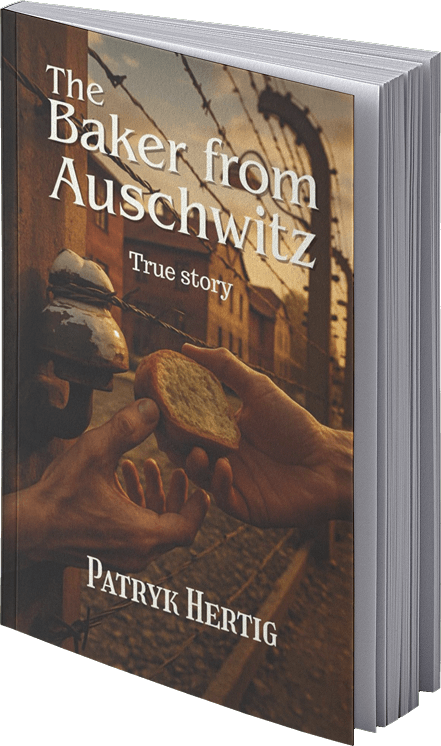
“The Baker from Auschwitz” is a family chronicle by Patryk Hertig about the love of his grandparents—Halina Bańko and Edward Hertig—a love that helped them survive the hell of the camps and build a life after the war. Risking everything, they baked extra loaves and smuggled bread, saving hundreds—if not thousands—of lives. It is a story where love is not an escape from reality but a force that lifts people back to their feet; its natural extension is the pursuit of peace—everyday, quiet choices against hatred and indifference. The author writes to preserve memory and pass on a testament: “Auschwitz did not fall from the sky” and “The eleventh commandment—do not be indifferent.”
The book speaks to younger generations, blending emotion with concrete detail about life under occupation and in the camps of Auschwitz, Birkenau, and Ravensbrück.

The Story
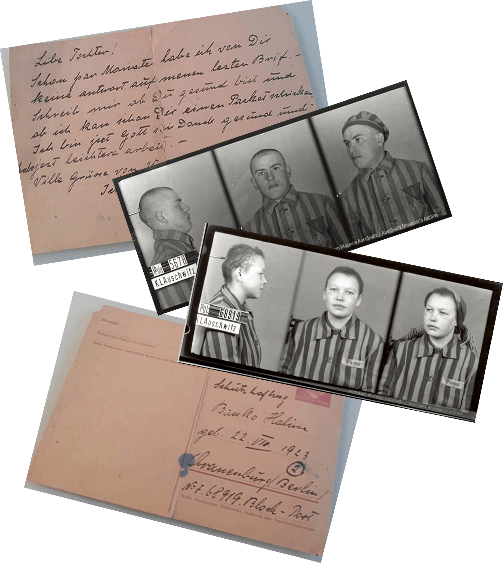
On March 8, 1943, in that bakery, Halina meets Edward Hertig (prisoner no. 5678). It is “love at first sight”—she passes him a bar of chocolate and a bottle of homemade lemon vodka, and he kisses her for the first time.
Soon after, Halina is arrested twice (May and October 1943), sent to Block 11, and then to Birkenau (no. 68919). She works in field commandos and mending clothes, is later transported to Ebingen, and evacuated to Ravensbrück and Eberswalde. In April 1945, the Swedish Red Cross evacuates her via Denmark to Sweden; she returns to Poland on November 2, 1945.
Edward—a baker from Bukowsko—had already been arrested in June 1940 for helping people escape to Hungary. He passes through prisons and camps, including Auschwitz, later Neuengamme and Buchenwald; in 1943 he also describes a medical “experiment” in the camp hospital.
After the war, the Hertigs rebuild their lives. Edward helps with the construction of St. Maximilian’s church in Oświęcim. To the author, they embody tenderness, perseverance, and faith—their fate becoming a lens for reflecting on memory and responsibility.

Characters
Halina Bańko (Hertig)
A native of Oświęcim who secretly aided prisoners; arrested twice and deported to Auschwitz-Birkenau (camp no. 68919), later to Ravensbrück. Member of the Home Army (AK), “Sosienki” partisan group. After the war she returned to Poland. She was driven by hope and love.
Edward Hertig
A baker from Bukowsko, imprisoned from 1940 (including Auschwitz, Neuengamme, Buchenwald), camp no. 5678. In 1943 he worked at the Oświęcim bakery, where he met Halina; after the war he became the pillar of his family and was active in the community.
Excerpts
Reviews
“This is a book that strikes with simplicity and truth. The author doesn’t dwell on cruelty; instead, he guides us through the concrete: dates, places, everyday choices from which courage is born. The love between Halina and Edward works like a lighthouse—it doesn’t sugarcoat reality, it illuminates it. I read it several times, each time discovering new details. Perfect for conversations with students about responsibility and remembrance. It stays with you long after the last page.”
Anna, history teacher
“It’s rare to find such an honest account of war and the camps. Hertig never loses sight of the human being—of hunger and fear, and yet also the desire to do good. Excellent pacing, well-chosen source fragments, zero pathos. A moving record of how ‘small’ gestures—bread, chocolate, a letter—can save lives. For me, it’s essential reading that teaches the past is not a closed museum, but a responsibility here and now.”
Marek, nonfiction enthusiast
“‘The Baker of Auschwitz’ is a book that’s easy to recommend and hard to forget. Family threads intertwine with documentary material so naturally that the reader flows through the story despite the weight of the subject. What I value most is the tenderness of the narration: no shouting, no cheap effects, and yet tremendous strength. It’s a story that helps you rise from your knees, reminds you of ‘non-indifference,’ and leaves a clear mark on the heart.”
Dorota, librarian